Articles

Why Does the Classic BNC Connector Endure in Test & Broadcast Applications? A Complete Guide of BNC Connector!
26-06-25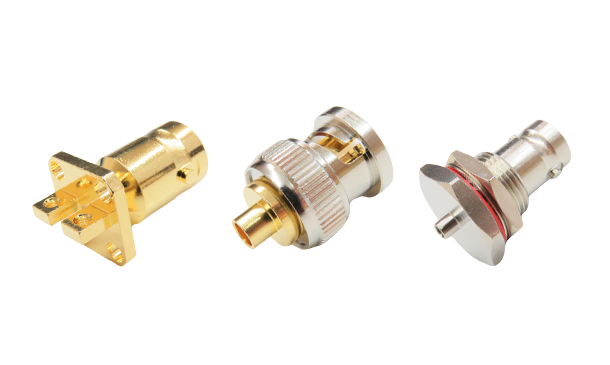
The choice of connectors directly impacts signal integrity and system stability in the fields of radio frequency (RF) and video transmission. Among these, the BNC connector has long served as the standard interface for test instruments and broadcast systems, thanks to its classic bayonet-style quick-lock mechanism and stable electrical characteristics.
Even today, as new connectors designed for ultra-high frequencies continue to emerge, the BNC connector maintains a high adoption rate in professional fields due to its intuitive operation, high durability, and excellent cost-effectiveness. This article will provide an in-depth analysis of the structural principles and practical applications of the BNC connector, elucidating its irreplaceable role in modern technology.
What Is the BNC Connector? A Basic Introduction of BNC Connector
The BNC connector is a classic coaxial RF connector. Its most distinctive feature is its bayonet-style rotating locking mechanism, which ensures electrical stability while offering unparalleled ease of use. The BNC connector remains an indispensable standard interface in the fields of test and measurement, broadcast video, and telecommunications nowadays.- Key Features
- Quick Connect: The BNC connector locks into place with a simple push and a quarter-turn, making it more suitable for environments requiring frequent plugging and unplugging compared to the threaded SMA connector.
- Mechanical Stability: The BNC connector’s bayonet lock mechanism provides stable contact pressure, preventing loosening or signal dropouts even in environments with slight vibrations.
- Durable Construction: The robust metal housing design allows the BNC connector to withstand repeated insertion and removal without affecting its characteristic impedance.
- Basic Technical Specifications of BNC Connectors
| Item | Description |
| Impedance | 50 Ohm (Data/Communications) / 75 Ohm (Video/Broadcast) |
| Frequency Range | DC to 4 GHz (Higher frequencies available in high-quality versions) |
| Connection Type | Bayonet Lock |
| Main Material | Body: Typically nickel-plated brass Center pin: Brass, phosphor bronze (or beryllium copper) with gold plating |
- Key Differences in BNC Connectors: 50 Ohm vs. 75 Ohm
- 50 Ohm BNC connector (RF and test): The most common specification, widely used in oscilloscopes, signal generators, and radio equipment. Its interior is typically filled with white dielectric material (insulator).
- 75 Ohm BNC connector (video and broadcasting): Designed specifically to minimize video signal reflections, it is used in CCTV systems, professional cameras, and SDI high-definition transmission. The internal structure of the 75 Ohm BNC connector is less dense, with reduced dielectric material to maintain impedance.
Why Has BNC Endured? An Introduction to the Core Advantages of BNC Connectors!
In today’s rapidly evolving technological landscape, many connectors have become obsolete due to their inability to meet demands for higher frequencies and smaller sizes. Yet, the BNC connector remains a steadfast staple. This is no coincidence rather it stems from the connector’s perfect balance of ease of use, cost-effectiveness, and durability. This resilience is primarily attributed to its irreplaceable qualities across the following five dimensions.- Quick-lock mechanism (bayonet design)
- Advantage: Compared to SMA connectors that require repeated threading, BNC significantly reduces installation time.
- Applications: In testing environments requiring frequent plugging and unplugging (such as switching oscilloscope probes) or urgent on-site setups (like live broadcast trucks), this speed translates directly into productivity.
- Exceptional Value for Money (Cost-Performance Ratio)
High Value for Money (Excellent Cost-Performance Ratio): This includes
- Low cost
- Mature manufacturing processes
- Stable market supply
- Stable Supply: Global market supply is extremely abundant, resulting in low procurement risk.
- Applications: In surveillance systems (CCTV) or large broadcasting centers requiring the deployment of hundreds of connection points, BNC significantly reduces project budgets while maintaining performance.
- High mechanical strength and durability
- Structure: The BNC connector’s sturdy metal housing offers excellent resistance to pulling and impact.
- Stability: Once locked, the connection is extremely stable and resistant to environmental vibrations.
- Applications: Ideal for field engineering, outdoor exploration equipment, or industrial control environments requiring long-term operation.
- Industry Standard Status
- Global compatibility: The BNC connector is the universal language of the RF field, with globally standardized specifications.
- Global standard specifications
- Supported by nearly all test equipment
- Plug-to-use
- Plug-to-Use: Nearly all mainstream test instruments (oscilloscopes, spectrum analyzers, signal generators) come standard with BNC sockets, so engineers no need to worry about interface incompatibility or a lack of adapters.
- Ample Frequency Performance
- General RF testing: Handles signals from hundreds of MHz to 4 GHz with stability and reliability.
- Professional video transmission: Supports high-quality SDI (Serial Digital Interface) video and broadcast-grade signals.
Where Are BNC Connectors Used? An Introduction of Application Areas
Thanks to their quick-lock and high adaptability advantages, BNC connectors have become a universal connector across multiple industries. Below are the seven core areas where BNC connectors are widely used.- Test and Measurement Equipment
- Common Equipment: Oscilloscopes, signal generators, spectrum analyzers, and vector network analyzers (VNAs).
- Core Benefits: Stable impedance (typically 50ohm) and low cost, making them ideal for large scale deployment of test nodes.
- Video & Broadcast
- Application Scenarios: SDI video transmission, TV station control room equipment, professional camera systems.
- Core Value: BNC connectors primarily use 75Ohm, featuring extremely low signal loss and high interference resistance, making them suitable for supporting long distance transmission of high definition video.
- Surveillance Systems (CCTV & Security)
- Application Scenarios: Analog monitors, DVR recording systems.
- Core Value: Simple installation, stable and durable construction, and highly competitive deployment costs.
- Communication Equipment and RF Applications
- Applications: Wireless communication testing, RF signal distribution, and basic antenna connections.
- Key Benefits: Suitable for the MHz to low GHz range, making it highly convenient for debugging and signal verification during the development phase.
- Education and Laboratories
- Applications: Electronics lab courses, communications theory training, and basic measurement instruction.
- Key Benefits: Intuitive operation (locks with a single twist), robust construction that resists accidental damage by students.
- Industrial and Automation Equipment
- Applications: Signal monitoring systems, test fixtures, and automated control transmission.
- Core Value: Strong interference resistance and a robust structure capable of withstanding the demands of long-term factory operation.
- Medical and Scientific Instruments
- Applications: Medical imaging equipment, diagnostic instruments, and pulse detection in scientific research.
- Core Value: Provides highly reliable electrical contact, ensuring that precise data is not compromised by connection errors.
Q1: Do 50 Ohm and 75 Ohm BNC connectors look the same? Can they be used interchangeably?
Answer: Although they look almost identical, they must never be used interchangeably.
Technical Differences:
50 Ohm BNC connector: The center pin is thicker, and the interior is filled with white insulating dielectric material, complying with MIL-STD-348 specifications for general RF testing.
75 Ohm BNC connector: The center pin is thinner (or hollow), contains less insulation, and is specifically optimized for video transmission impedance.
Consequences of mixing: Impedance mismatch will cause severe signal reflection (deteriorated return loss) and reduced transmission quality, and may even result in significant errors in precision measurements.
Q2: Are BNC connectors and TNC connectors interchangeable?
Answer: No. Although the interface dimensions are similar, the locking mechanisms are completely different.
BNC connector: Uses a bayonet and quick-lock design that requires a 1/4-turn.TNC connector: This is the threaded version of the BNC connector, which locks by rotating the threads.
Comparison of Advantages: TNC connectors offer higher operating frequencies and better vibration resistance than BNC connectors. If your equipment is subject to severe vibration, you should prioritize using TNC connectors.
Further Reading: What Is a TNC Connector? Differences from BNC, Advantages, Applications, and Usage Explained
Q3: Is BNC suitable for 5G applications?
Answer: No, it is not suitable. 5G signals operate at extremely high frequencies, and the design of BNC connectors inherently lacks the necessary advantages.
Limitations: Insufficient frequency capability, higher signal loss, and impedance control precision that cannot meet the demands of 5G millimeter-wave technology.Common 5G Choices: The industry typically selects high frequency miniature connectors such as SMA, 2.92mm (K Connector), or SMP/SMPM.
Q4: What is the maximum supported frequency for a BNC connector?
Frequency capability depends on the manufacturing process and the standards followed (e.g., MIL-STD-348):
General commercial grade: Approximately 1~2 GHz
High quality RF grade: Approximately 3~4 GHz
Practical advice: When signal frequencies exceed 1 GHz, strict control over cable quality and issues related to loss and reflection at connection points is essential.
Q5: Are BNC connectors prone to loosening? What is their lifespan?
Stability: Under normal conditions, the bayonet lock is very secure. However, in high-vibration environments, it is recommended to switch to TNC threaded connectors.
Lifespan: High quality BNC connectors are manufactured to standards and can typically withstand over 500 insertion and removal cycles.
Q6: How do you disassemble a BNC connector?
The process is very simple. Hold the connector housing at the knurled section. Gently push inward and rotate counterclockwise about 1/4 turn. Once you feel the latch release, you can pull it out. Never pull directly on the cable, as this may damage the crimp points.
Q7: Why is the signal still unstable after connecting the BNC connector?
Please check the following common causes in order.
- Impedance mismatch: Accidental mixing of 50 Ohm and 75 Ohm cables.
- Loose connection: The connector was not rotated fully into place, resulting in poor contact.
- Oxidation of contact points: The BNC connector has been exposed to a humid environment for an extended period. We recommend cleaning the contacts or replacing them with high quality gold-plated connectors.
- Poor assembly: The cable and connector are not crimped securely.
Professional BNC Connector Manufacturer – Huang Liang Technologies
When selecting RF BNC connectors, specifications are merely the basic requirement. The key factors that truly impact system stability lie in manufacturing quality, impedance control, and long-term reliability. Huang Liang Technologies has established a strong presence in the RF connector and cable assembly sector, specializing in providing high quality, stable, and reliable BNC connector solutions that are widely used in test and measurement, communication equipment, and industrial applications. Huang Liang Technologies offers the following advantages.- Product and Technical Advantages
| Item | Description |
| Complete Product Line | We offer 50Ohm / 75Ohm BNC connectors in various types, including plugs, jacks, and bulkheads |
| Cable Compatibility | Supports multiple coaxial cable types (RG58, RG59, RG6, etc.) |
| Impedance Control | Precisely maintains 50Ω / 75Ω impedance to reduce signal reflection (Return Loss) |
| Shielding Performance | Excellent electromagnetic shielding capability, reducing external interference |
| Mechanical Stability | Sturdy bayonet structure, resistant to loosening even with prolonged use |
| Quality Control | Strict manufacturing processes and inspections ensure consistency and reliability |
- Customization and Service Capabilities
| Item | Description |
| Cable Assembly | Custom cable lengths and connector combinations available |
| Connector Integration | Supports various interface combinations such as BNC, SMA, and TNC |
| Application Design | Assistance with test platform and system integration requirements |
| Technical Support | Providing product selection recommendations and application consulting |
- Wide Range of Applications
| Application Types | Use Cases |
| Testing and Measurement | Oscilloscopes, signal generators, spectrum analyzers |
| Broadcasting and Video | SDI transmission, broadcast equipment, camera systems |
| Surveillance Systems | CCTV, DVR Equipment |
| Communication Equipment | RF Testing, Signal Connectivity |
| Industrial Applications | Automation Equipment, Signal Monitoring |
| Educational Labs | Teaching and Laboratory Equipment |
- Why Choose Huang Liang Technologies?
| Advantages | Description |
| Consistent Quality | Suitable for long-term operation and environments with frequent plugging and unplugging |
| High Cost Performance Ratio | Mature manufacturing process, balancing cost and performance |
| Reliable Supply | Capable of meeting long-term project and mass production needs |
| Professional support | Assistance in quickly finding the right solution |
Choosing the right BNC connector is not just about matching specifications. It also affects the overall stability and efficiency of the system. With our professional manufacturing capabilities and technical expertise, Huang Liang Technologies provides reliable RF connection solutions to help you achieve stable and reliable signal transmission across a wide range of applications.
Conclusion
Thanks to its bayonet design, stable impedance characteristics, and cost-effectiveness, the BNC connector has long played a critical role in testing and measurement, video, and various communication applications. Even amid the rapid development of high frequency connectors, the BNC connector continues to be widely adopted for striking a good balance between stability, convenience, and cost.For engineering applications, selecting high quality BNC connectors not only enhances signal transmission quality but also reduces long-term maintenance costs and the risk of failures. If you have further product inquiries or application related questions, please feel free to contact us at any time for comprehensive product information and professional advice.